


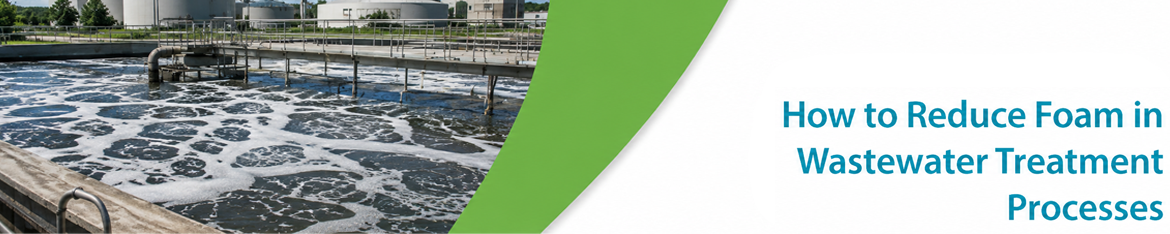
How to Reduce Foam in Wastewater Treatment Processes
Foam in a wastewater treatment plant can quickly become more than a visual nuisance. Excessive foam in an aeration basin can overflow onto walkways, railings, equipment, and surrounding work areas, creating cleanup demands, slippery surfaces, and potential risk to nearby electrical components. It can also reduce usable basin capacity and consume operator time that should be focused on keeping treatment performance stable.
The operational consequences can be even more significant. Persistent biological foam associated with filamentous organisms, such as Microthrix parvicella and Nocardia-like organisms, may signal an imbalance within the activated sludge process. In other cases, surfactants, detergents, or industrial discharges can generate heavy chemical foam. If foam carries suspended solids or poorly treated material into downstream clarification or effluent, the problem can begin to affect treatment quality and potentially complicate permit compliance.
Reducing wastewater foam starts with understanding what’s creating it. Once the source is identified, operators can determine whether the solution requires process adjustments, a properly selected defoamer, or a combination of both.
Take Control of Wastewater Foam
Understanding the Root Causes of Wastewater Foaming
Foam can develop anywhere air, agitation, and foam-stabilizing substances come together. In activated sludge systems, however, two broad categories account for many persistent problems: biological foaming and chemical foaming.
Biological Foaming: Filamentous Bacteria
Thick, stable foam with a brown or tan appearance is frequently associated with filamentous microorganisms.These microorganisms can accumulate at the air-water interface and become trapped in rising air bubbles. Their hydrophobic surfaces help create a persistent foam layer that can be difficult to collapse mechanically.
Conditions that may contribute to this type of foaming include high fats, oils, and grease loads, long sludge ages, changes in dissolved oxygen, and other conditions that favor filamentous organisms over desirable floc-forming bacteria.
A defoamer can help control the immediate operational effects of biological foam, particularly when foam is consuming tank volume or approaching an overflow condition. (Note: It should not, however, be treated as a replacement for correcting the biological conditions that allowed the problem to develop.)
Operators should evaluate sludge age, dissolved oxygen, influent characteristics, FOG loading, and microscopy results when persistent biological foam appears.
Chemical Foaming: Surfactants and Detergents
Chemical foam often behaves differently. High concentrations of detergents, cleaners, surfactants, process chemicals, or certain industrial wastewater streams can stabilize air introduced through aeration and mixing. Municipal sewage can also contribute to foaming when influent contains elevated concentrations of household detergents and other surfactants, particularly as the wastewater enters aerated biological treatment.
This foam is frequently lighter and more billowy than mature biological foam and may be white or light in color. Appearance alone should not be used as the diagnosis, however. Influent history and plant operating data are usually more useful.
A sudden increase in foam may indicate a change upstream, such as a new industrial discharge, cleaning cycle, production formulation, or unusually high surfactant load. In these situations, controlling foam can help restore usable basin capacity and stabilize plant operation while operators determine whether the influent source can also be reduced or corrected.
Selecting the Right Defoamer Chemistry for Your Plant
There is no single wastewater defoamer that is optimal for every plant. Wastewater composition, temperature, pH, dissolved solids, aeration intensity, treatment biology, and downstream equipment all affect performance.
PMC Ouvrie manufactures several types of wastewater foam-control chemistry, including silicone products, silicone-free products, esterified polyols, fatty-alcohol emulsions, and other formulations for specific wastewater applications.
Silicone-Based Defoamers
Silicone-based defoamers can provide rapid foam knockdown and strong performance at relatively low treatment rates. Their ability to spread quickly across the foam surface makes them particularly useful when operators need to bring severe chemical foam under control.
The strongest chemistry is not automatically the best chemistry.
Plants should consider downstream treatment requirements before choosing a product. Compatibility with membranes, filtration equipment, coatings, biological treatment, discharge limitations, and subsequent process stages should all be evaluated.
For plants experiencing intermittent high-volume foam, a silicone formulation may provide the combination of quick knockdown and persistence needed to restore operating capacity without excessive chemical consumption.
Non-Silicone and Oil-Based Alternatives
Some systems are better suited to silicone-free formulations.
Fatty-alcohol emulsions, esterified products, surfactant blends, and other non-silicone chemistries can provide effective foam control while addressing specific process or downstream compatibility requirements.
This can be particularly important at facilities using membrane bioreactors or other sensitive downstream membrane systems. Antifoam chemistry should be reviewed with both the chemical supplier and membrane manufacturer rather than assuming that every silicone or non-silicone product will behave the same way.
The objective is not simply to find a chemical capable of collapsing foam. It is to find the formulation that controls the foam without introducing a new problem elsewhere in the treatment process.
Application Best Practices: Dosing and Injection Points
Even an appropriate defoamer can perform poorly if it’s applied in the wrong location or at an unnecessarily high dosage.
Where to Inject Defoamers for Maximum Efficacy
Whenever possible, introduce the defoamer where the wastewater provides enough turbulence to disperse the product before the major foam-generating stage.
For an aeration basin, this may mean dosing into the wastewater stream shortly before it enters the basin. This gives the defoamer an opportunity to disperse before aeration creates a large foam blanket.
For localized foam that occurs farther downstream, treatment closer to the problem area may be more efficient. Direct application or dosing near an effluent channel or launder may be appropriate when foam is limited to that portion of the process.
The best injection point depends on where foam forms, how quickly the defoamer disperses, and which treatment stages follow. Dosing too far upstream can reduce efficiency and increase unnecessary chemical use, while dosing too late may require a higher corrective dose after foam has already disrupted operations.
Calibrating Dosing Rates to Prevent Over-Treatment
The goal is to identify the minimum effective dosage that achieves reliable control under normal and peak operating conditions. Bench testing or plant trials are often the best starting point.
For water-based streams, 1 ppm is approximately equal to 1 mg/L. A basic dosing estimate can be calculated as:
Chemical required (kg/day) = Plant flow (m³/day) × target dose (mg/L) ÷ 1,000
For example, a plant treating 2,000 m³ per day at an initial target dose of 10 mg/L would require approximately 20 kg of product per day.
If the product has a density of 0.95 kg/L:
20 kg/day ÷ 0.95 kg/L = approximately 21 liters/day
These calculations provide a starting estimate only. Actual dosage should be adjusted based on the specific defoamer, wastewater characteristics, foam response, process conditions, and product concentration.
Not sure what dosage or defoamer is right for your system? Ask PMC Ouvrie About Your Wastewater Application.
Plants with highly variable industrial influent may also benefit from adjusting feed rates as foam conditions change rather than maintaining an unnecessarily high constant dose.
Environmental Compliance and Toxicity Standards
Wastewater defoamers become part of the treatment stream, so effectiveness cannot be separated from environmental compatibility.
PMC Ouvrie offers wastewater defoamers developed with low toxicity and biodegradability considerations and formulations designed for foam control in oxygenation basins without compromising dissolved oxygen performance.
Product selection still needs to be application-specific. Discharge permits, activated sludge biology, downstream treatment, membrane compatibility, receiving-water requirements, and the chemical characteristics of the wastewater should all be considered before establishing a permanent treatment program.
A technically appropriate defoamer should help the plant regain control of foam without undermining the biological treatment process it is intended to protect.
Frequently Asked Questions About Wastewater Foam
What is the fastest way to reduce foam in a wastewater treatment plant?
For an immediate foam problem, an appropriately selected defoamer can provide rapid knockdown. Persistent problems should also be investigated for biological, surfactant, FOG, aeration, or influent-related causes so the plant is not relying on chemical treatment alone.
How can I tell if wastewater foam is biological or chemical?
Thick, persistent brown or tan foam can be associated with filamentous organisms such as Microthrix or Nocardia-like organisms, while surfactant foam is often lighter and more billowy. Visual appearance is not conclusive. Microscopic evaluation, influent history, sludge age, dissolved oxygen, and process data provide a more reliable diagnosis.
Can too much defoamer cause problems?
Yes. Excessive dosing increases treatment cost and can potentially affect downstream treatment or product compatibility. Plants should determine the minimum effective concentration through testing and adjust dosing as wastewater conditions change.
Are silicone defoamers safe for membrane bioreactors?
Compatibility depends on the specific defoamer formulation and membrane system. Plants using MBRs should verify the proposed chemistry with the defoamer supplier and membrane manufacturer. Where required, silicone-free alternatives can be evaluated.
Where should wastewater defoamer be added?
The ideal location is generally close enough to the foam-generating stage to avoid unnecessary chemical consumption but far enough upstream to provide good dispersion. Aeration basin influent, well-mixed upstream channels, and localized downstream treatment points are common options depending on the process.
Get the Foam Problem Under Control
Persistent wastewater foam can cost a plant usable capacity, operator time, chemical spend, and process stability.
PMC Ouvrie works with industrial operations to evaluate the application, foaming medium, process conditions, temperature, pH, operating limitations, and method of application before selecting a foam-control solution.
Dealing with persistent aeration basin foam? Request a free site audit. Our engineers will analyze your sludge profile and custom-formulate a defoamer specifically for your plant's biology.