


Choosing a Defoamer for Polymerization: What Changes Between Emulsion, Suspension, and Stripping
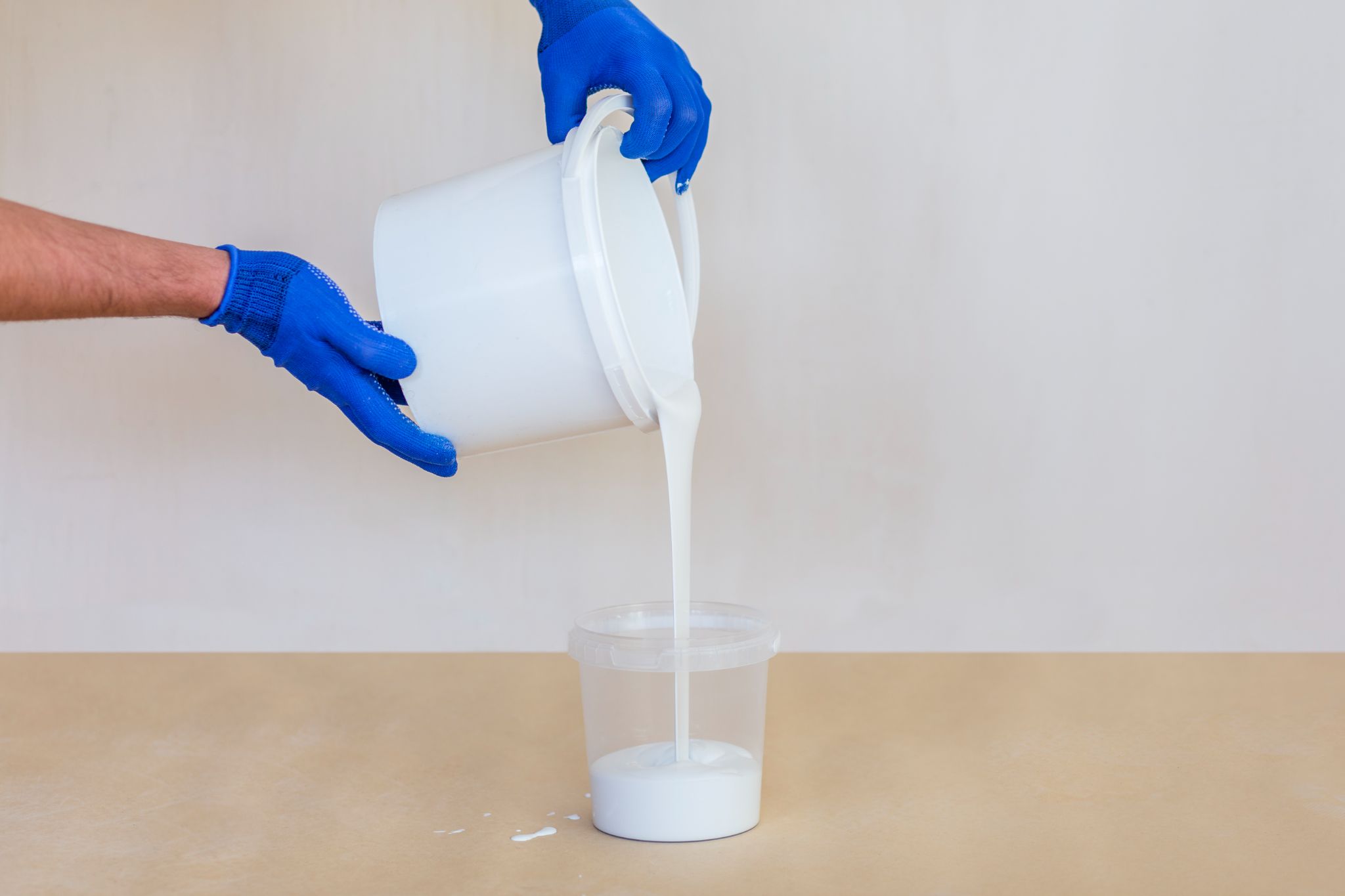
Most defoamer decisions in polymer plants are made under pressure. Foam climbs during a batch, someone reaches for the product that worked last time, and it either holds or it doesn’t. If it holds, that product becomes the default for every process on the site, including ones it was never tested in.
At PMC Ouvrie, we supply defoamers to polymer producers, and we don’t make polymers. The mistake we see most often is treating a defoamer as a single decision when the process is really three or four different foam problems. This article covers how to choose the right defoamer for a polymerization process, and what changes from one stage to the next.
How to Choose a Defoamer for Polymerization: Start With the Stage
To choose a defoamer for polymerization, start with the process stage (emulsion reaction, suspension reaction, or monomer stripping), then match the defoamer’s form and chemistry to your operating conditions and surfactant system. Use the lowest dose that holds foam, and confirm the result against polymer properties, not just foam height. Screen in your own system before scaling.
Why the Stage Matters
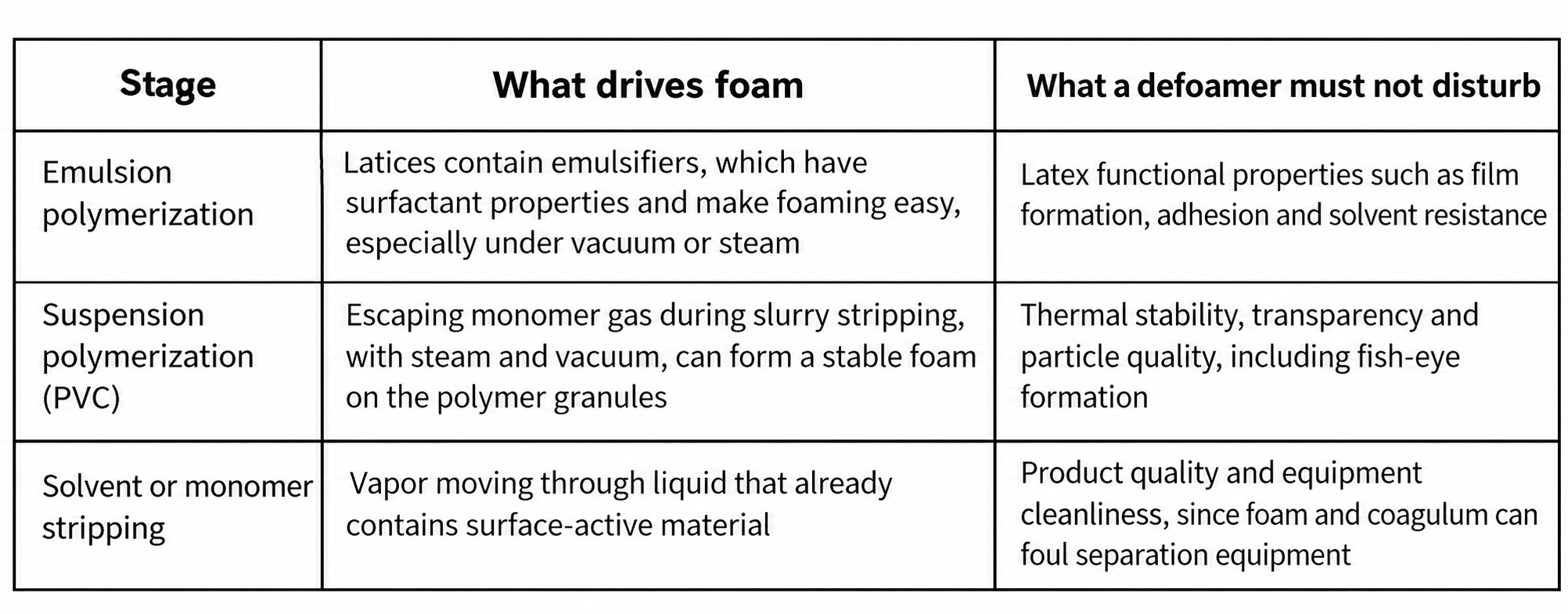
Foam behavior varies by recipe, so treat this as a map, not a rule. The useful point is that the “protect this” column differs by row. A defoamer that suits a latex can still be wrong for a PVC slurry, and the reverse.
What a Defoamer Has To Do
Published defoaming research is consistent on the basics. A defoamer must be insoluble in the system it treats, present as fine droplets or particles, and able to enter the thin film around each bubble and spread across it or bridge it until the film ruptures. Hydrophobic particles, such as those in wax dispersions, can lower the barrier to entry.
This explains a common failure. A product that is too compatible dissolves and loses effect. One that is too incompatible disperses poorly and can leave residue. HLB (hydrophilic/lipophilic balance) describes this balance, which is why our DELFOAM and EROL ranges are designed with carefully balanced values for compatibility across polymer systems. We treat HLB as a screening guide, not proof of performance in your recipe.
What Our Product Forms Tell You
Form matters as much as chemistry. Our polymerization range includes an emulsion of fatty alcohols (DELFOAM P87, for SBR and NBR), wax dispersions (DELFOAM P442M for SBR, NBR and PVC, and EROL AMP 19 MOD 1 for rubber and plastics), a PVC dispersion (DELFOAM DEV 1232) and a blend of surfactants (DELFOAM CD 234, for rubber and plastics). Form affects how a defoamer disperses in your system, how it is dosed, and how it behaves in the finished polymer, so no single form is universally right.
Six Questions to Answer Before You Screen
- Which stage is foaming? Reaction and stripping can need different products.
- What are your temperature and pH windows? Include excursions, not just set points.
- What is your surfactant or dispersant package? It sets foam stability and defoamer compatibility.
- How is the defoamer dosed? Continuous, event-driven, or pre-charged changes what you test.
- What must the polymer do afterward? Film properties, clarity, thermal stability, and cleanliness are the usual constraints.
- Does the end use carry regulatory requirements? Food-contact use, for example, changes which grades are candidates.
What a Poor Match Can Cost
The costs depend on the product and system, and they are worth testing for. In latex processing, antifoams added during stripping have been reported to affect properties such as film formation, adhesion, and solvent resistance. In PVC, the concern is whether the defoamer affects properties such as thermal stability or transparency. Foam itself can also cause trouble: slurry foam that reaches a reactor’s top or condenser can hurt heat transfer and, in some systems, contribute to defects such as fish eyes. Overdosing tends to magnify all of these.
How to Run a Defoamer Trial
- Record a baseline: foam height, usable fill, defoamer consumption and batch variation.
- Screen at process conditions: real temperature, agitation and recipe.
- Find the lowest effective dose, then check the margin above it.
- Test the polymer, not just the foam, against the properties you’re accountable for.
- Repeat closer to production scale, because foam behavior changes with agitation and volume.
How PMC Ouvrie Helps
We offer the DELFOAM and EROL lines for emulsion polymerization, suspension polymerization, and solvent stripping, used in producing polymers such as PVC, SBR, NBR, and ABS. Many references within these ranges are designed to comply with frameworks including EU Regulation 10/2011 and relevant FDA food-contact regulations. Because compliance depends on the application and formulation, we review requirements with each customer before recommending a grade.
See our polymerization defoamer range, then contact our technical team with your stage, conditions, and end-use requirements.
Conclusion
A defoamer that works in one polymerization stage says little about the next. Match the product to the stage, the surfactant system and the polymer’s requirements, then confirm it against the properties that matter, not just foam height.
FAQs
Does the polymer’s end use change which defoamer to choose?
Yes. If the polymer is used in food-contact applications, regulatory status becomes a selection criterion alongside performance, and it depends on the specific grade and application.
How do I know if the dose is too high?
Watch for changes in the polymer properties you track, residue or fouling in equipment, and rising consumption without better foam control. Any of these is a reason to revisit the dose or the product.
What should I re-test if we change the surfactant package or polymer grade?
Re-screen the defoamer. Surfactant type and level drive foam stability, and a change to either can alter how a defoamer performs.