


Defoamer or Antifoam? Why the Label Won’t Solve Your Foam Problem. What Will

A procurement team narrows its search to “industrial antifoam” instead of “defoamer,” reasoning that prevention sounds like the smarter buy. It’s a reasonable instinct. The word suggests something more proactive, and proactive sounds like it should perform better. Three suppliers respond to the request, all confidently labeled “antifoam,” and the products behave nothing alike once they hit the plant floor.
One knocks foam down fast and loses effectiveness within an hour. Another barely touches the foam already present but holds it back for a full shift. Nobody on either side misused the word. The word was never going to predict the outcome.
What Is the Difference Between a Defoamer and an Antifoam?
The terms defoamer and antifoam are often used interchangeably in industrial processing, although they can describe different foam-control purposes. A defoamer is commonly associated with knocking down foam that has already formed, while an antifoam may be used to prevent or limit foam formation during a process. In practice, the terminology varies by industry and supplier, so the product’s actual chemistry, application, and performance matter more than the label alone.
We cover the mechanics of that distinction in more depth on our R&D page, including how the two effects are often combined in a single product. This article picks up where that leaves off: given that the label doesn’t tell you much, what should?
Defoamer vs. Antifoam at a Glance
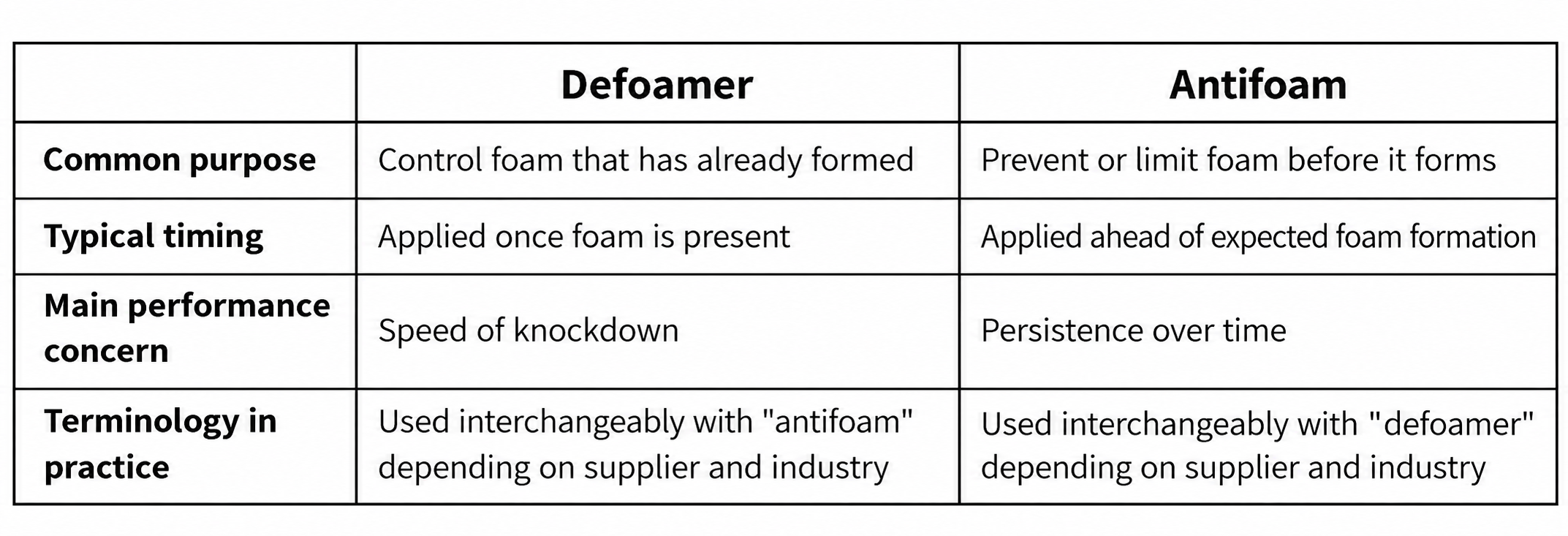
Treat this table as a starting orientation, not a technical boundary. Many products on the market, including several of our own, are formulated to do both jobs, so a supplier’s chosen label doesn’t guarantee the product fits only one side of this table.
Why the Terminology Confusion Costs Buyers Time
We’ve seen procurement teams filter supplier catalogs by “antifoam” versus “defoamer” as if it were a meaningful category, then wonder why a product that fit the label didn’t fit the process. The labeling tells you almost nothing about temperature range, pH tolerance, compatibility with your formulation, or how the product behaves under your actual agitation conditions. Spending evaluation time on terminology instead of these variables is time not spent on the decision that actually determines whether the product works.
What Actually Determines Whether a Product Fits Your Process
This is where the real evaluation happens, regardless of what the product is called:
- Foam behavior in your process. Is foam forming continuously, or does it build up and need knockdown at specific points? This shapes what performance you need, more than any label does.
- Temperature. The product needs to remain effective across your actual operating range.
- pH. Performance can shift with pH, particularly in aqueous systems.
- Shear and agitation. How hard your equipment works the liquid affects both foam formation and product performance.
- Formulation chemistry. What else is in your process stream affects compatibility.
- Required knockdown speed versus persistence. Some processes need fast action at a specific moment, others need sustained suppression over a longer run.
- Downstream sensitivity. Residual product can affect filtration, separation or finished-product quality depending on the chemistry and dose.
- Regulatory requirements, where applicable to your industry and end use.
None of these variables are answered by whether a product ships under the word “defoamer” or “antifoam.” They’re answered by testing the product against your actual conditions.
How Foam Control Requirements Differ Across Processes
The same underlying chemistry can be asked to do very different jobs depending on where it’s applied. In fermentation, the priority is often protecting oxygen transfer and organism health while controlling foam that builds during aeration. In sugar and distilling, foam control has to hold up through extraction, clarification and evaporation stages with different temperature and pH profiles at each one.
In wastewater treatment, the requirement is preventing aeration-tank overflow without disrupting dissolved oxygen levels needed for biological treatment. In construction materials, the concern shifts to entrained air affecting strength and density rather than overflow at all. In pulp and paper, foam has to be managed without interfering with fiber bonding, and in coatings, residue and compatibility become the dominant concern because of the effect on finished surface quality.
None of these applications care whether the product is called a defoamer or an antifoam. Each one has its own combination of conditions that determines what actually works.
Why Application-Specific Selection Matters More Than Terminology
The path to a working solution runs through the process, not the product category: identify the foam problem, establish the process conditions, narrow to compatible product chemistries, confirm dosage and persistence, and validate before committing to production use. Skipping straight from a supplier’s product label to an order is how mismatches happen. The label is a starting filter at best, not a selection method.
How to Evaluate a Defoamer or Antifoam for Your Process
- Determine whether foam is already present or continuously forming in your process, which shapes what performance profile you need.
- Establish your process conditions– temperature, pH, shear and agitation.
- Identify formulation and downstream constraints, including what else is in the system and what happens after foam control is applied.
- Evaluate candidate chemistries against those conditions, regardless of how they’re labeled.
- Test dosage and persistence in your actual system, not a simplified proxy.
- Check for unintended effects on compatibility, appearance or downstream processing.
- Validate under representative production conditions before adopting it as standard practice.
How PMC Ouvrie supports this evaluation
We supply both liquid and powder foam-control products across a range of industries, and our approach starts from your process conditions rather than a terminology preference. If you’re evaluating options for industrial biotechnology, wastewater treatment, or another application, our liquid defoamers range covers multiple chemistries suited to different process conditions. Contact our technical team with your specific requirements, and we’ll help identify what actually fits, not just what fits a label.
Conclusion
Whether a product is called a defoamer or an antifoam tells you almost nothing about whether it will work in your process. Evaluate against your actual conditions, foam behavior, temperature, pH, compatibility, and downstream requirements, and let those determine your choice rather than the terminology on the data sheet.
FAQs
If a supplier only offers “antifoam” products, does that mean they can’t handle foam that’s already formed?
Not necessarily. Terminology varies by supplier, and many products marketed as antifoams are formulated to address foam that’s already present as well as forming foam. Ask about performance against your specific foam behavior rather than relying on the product name.
Can the wrong foam-control product affect the finished product, not just the process?
Yes, depending on the chemistry, dose, and formulation. Residual product can influence appearance, stability, or downstream separation, which is one more reason to select based on your process rather than a label.
Should I test a product differently depending on whether it’s called a defoamer or an antifoam?
No. The evaluation steps- matching process conditions, testing dosage and persistence, checking downstream effects- are the same regardless of what the product is called.