


How Can You Tell If a Process Has Entrained Air or Surface Foam?

Entrained air consists of bubbles dispersed within a liquid, while surface foam is a collection of bubbles that builds up above the liquid. Both can occur in the same process, but they may cause different problems.
When comparing entrained air vs foam, the first step is to check where the bubbles are present. A thick layer of foam is easy to see, but air trapped within a liquid may be less obvious.
Understanding the difference helps operators decide what to investigate before changing a foam-control treatment.
What Does Entrained Air Look Like?
Entrained air consists of small bubbles suspended in a liquid.
Depending on the liquid and bubble size, it may appear cloudy, milky, or full of fine bubbles.
Common signs include:
- Fine bubbles visible throughout a liquid sample
- Changes in apparent liquid density
- Unstable readings from equipment affected by air
- Bubbles rising after a sample is left undisturbed
Entrained air can develop during mixing, pumping, spraying, or turbulent circulation.
Its effects depend on the process and the amount of air present.
What Does Surface Foam Look Like?
Surface foam forms when bubbles collect and remain above the liquid.
It may appear as a thin layer or a thick buildup, depending on the liquid composition and operating conditions.
Surface foam can cause problems when it overflows equipment, interferes with level measurement, or reduces usable tank space.
Unlike entrained air, surface foam is usually easy to identify through direct observation.
However, removing visible foam does not necessarily mean all the air within the liquid has been removed.
How Can You Identify the Difference?
Start with a sample taken according to the facility’s approved procedure.
Observe where the bubbles appear and how the sample changes when left undisturbed.
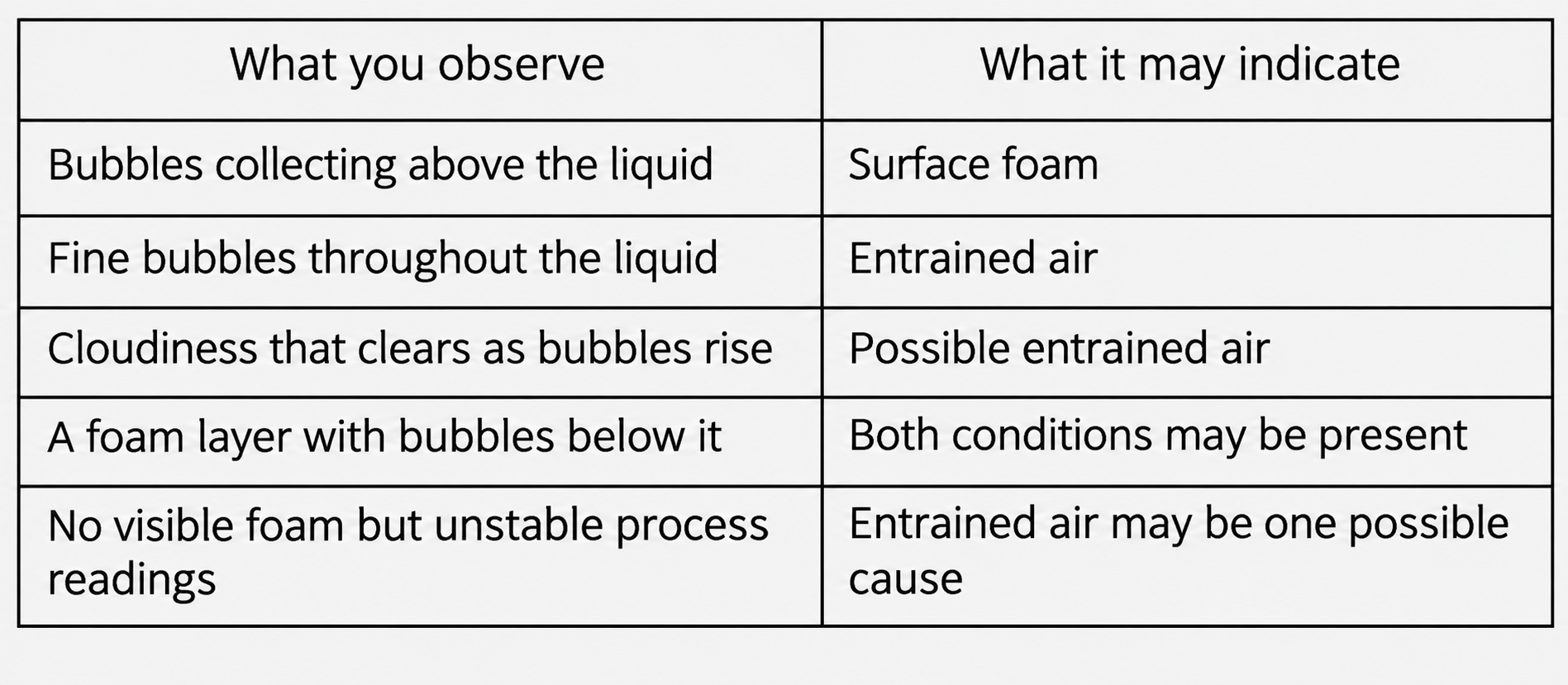
These observations are useful for initial troubleshooting, but they do not always confirm the cause.
Cloudiness can also result from suspended solids or emulsified materials. If the distinction affects process decisions, use an appropriate measurement method.
Can Entrained Air and Surface Foam Occur Together?
Yes. Air introduced during mixing or circulation can remain dispersed in the liquid, rise toward the surface, and contribute to visible foam.
The behavior depends on bubble size, liquid properties, and the presence of foam-stabilizing substances.
For example, a circulating liquid may contain fine air bubbles even when the surface foam layer is small.
This is why operators should check both the liquid and its surface rather than judging the problem only by the amount of visible foam.
Why Does the Difference Matter for Foam Control?
Entrained air and surface foam may require different treatment priorities.
If air enters through a pump suction problem or excessive agitation, equipment and operating conditions should be reviewed.
If surface foam remains stable because of the liquid’s chemistry, an appropriate antifoam or defoamer may help control it.
Some formulations can also support deaeration, but their performance depends on the application.
At PMC Ouvrie, we develop foam control solutions for different industrial processes.
Our research and development capabilities support product evaluation under relevant operating conditions.
What Should You Check Before Changing Treatment?
Before adjusting the defoamer, identify whether the main problem is surface foam, entrained air, or both.
Then review:
- Where air enters: Check mixing, pumping, and liquid returns.
- When bubbles appear: Compare startup, steady operation, and process changes.
- What has changed: Review recent ingredient and equipment adjustments.
- How the current treatment performs: Check whether it reduces surface foam, dispersed bubbles, or both.
Record the results so the technical team can compare conditions.
Avoid increasing the dose based only on the appearance of surface foam.
Frequently Asked Questions
Can a liquid contain entrained air without visible foam?
Yes. Fine bubbles can remain dispersed in a liquid even when little or no foam collects on its surface.
Does removing surface foam also remove entrained air?
Not necessarily. A treatment may reduce visible foam without eliminating all the bubbles suspended in the liquid.
Is every cloudy liquid affected by entrained air?
No. Cloudiness may also come from suspended solids, emulsions, or other materials. Further testing may be needed.
Need Help Evaluating an Air or Foam Problem?
Knowing whether you’re dealing with entrained air, surface foam, or both is an important first step toward choosing a suitable treatment.
At PMC Ouvrie, we help industrial manufacturers evaluate foam-control options based on their process conditions.
Contact our team to discuss your application.