


Why Does an Antifoam Work in the Lab but Fail in Production?
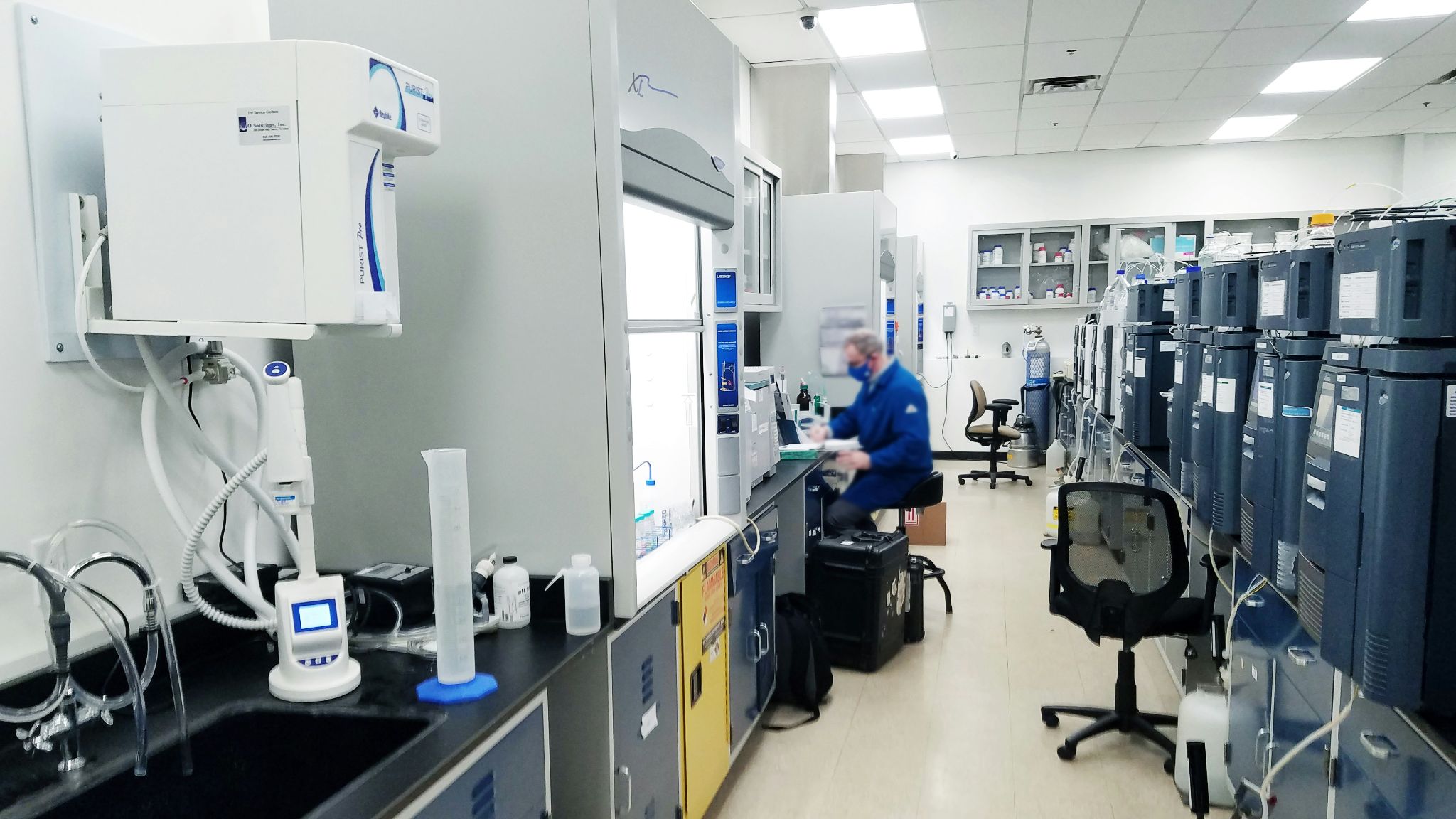
An antifoam may work in the laboratory but fail in production because the test does not fully reproduce how foam forms in the plant. Differences in mixing, air introduction, dosing, and operating duration can change the product’s performance. A formulation that quickly reduces foam in a small sample may not provide the same control in a continuously operating system.
When investigating antifoam lab vs plant performance, the first step is to identify what the laboratory test did not represent.
Why Don’t Laboratory Results Always Match Production?
Laboratory tests help manufacturers compare antifoam formulations under controlled conditions.
However, production equipment may expose the liquid to different types of mixing, circulation, and air introduction.
For example, an antifoam may perform well when a sample is shaken briefly. The same product may behave differently when the liquid is pumped continuously through a production system.
This does not automatically mean the antifoam is unsuitable. It may mean the original test did not adequately represent the process.
What Should You Check When Plant Performance Falls Short?
1. How foam is being generated
Start by comparing the source of foam in the laboratory and the plant.
A laboratory test may generate bubbles by shaking a container, while production foam develops during pumping, spraying, or continuous agitation.
These methods do not necessarily create the same bubble conditions.
Identify the equipment or process stage where foam first develops. Then determine whether the laboratory procedure represents that mechanism.
2. Where the antifoam is added
An antifoam must reach the liquid where its action is needed.
In a small laboratory vessel, the product may be mixed evenly throughout the sample.
In production, the addition point, liquid movement, and mixing conditions can affect how the treatment is distributed.
Check whether the antifoam enters the intended process stream and whether the dosing equipment is operating correctly.
The appropriate addition point depends on the process and formulation.
3. How long the antifoam must remain effective
A short laboratory test may show rapid foam reduction without demonstrating performance over an entire production cycle.
In a plant, the liquid may circulate repeatedly or encounter several foam-generating stages.
A product that provides good initial foam reduction may not maintain the required control throughout operation.
Compare the laboratory test duration with the actual time the treatment needs to remain effective.
4. Whether the tested dose matches the production dose
Confirm how the antifoam concentration was calculated in both settings.
For example, a laboratory dose may be recorded relative to a small liquid sample, while production dosing is based on batch size or process flow.
Differences in calculation, product preparation, or dosing accuracy can affect the comparison.
Check that both tests use consistent units and the intended product concentration.
Do not increase the production dose simply because the laboratory result was better.
How Can You Find the Main Difference?
Use a structured comparison rather than changing several variables at once.
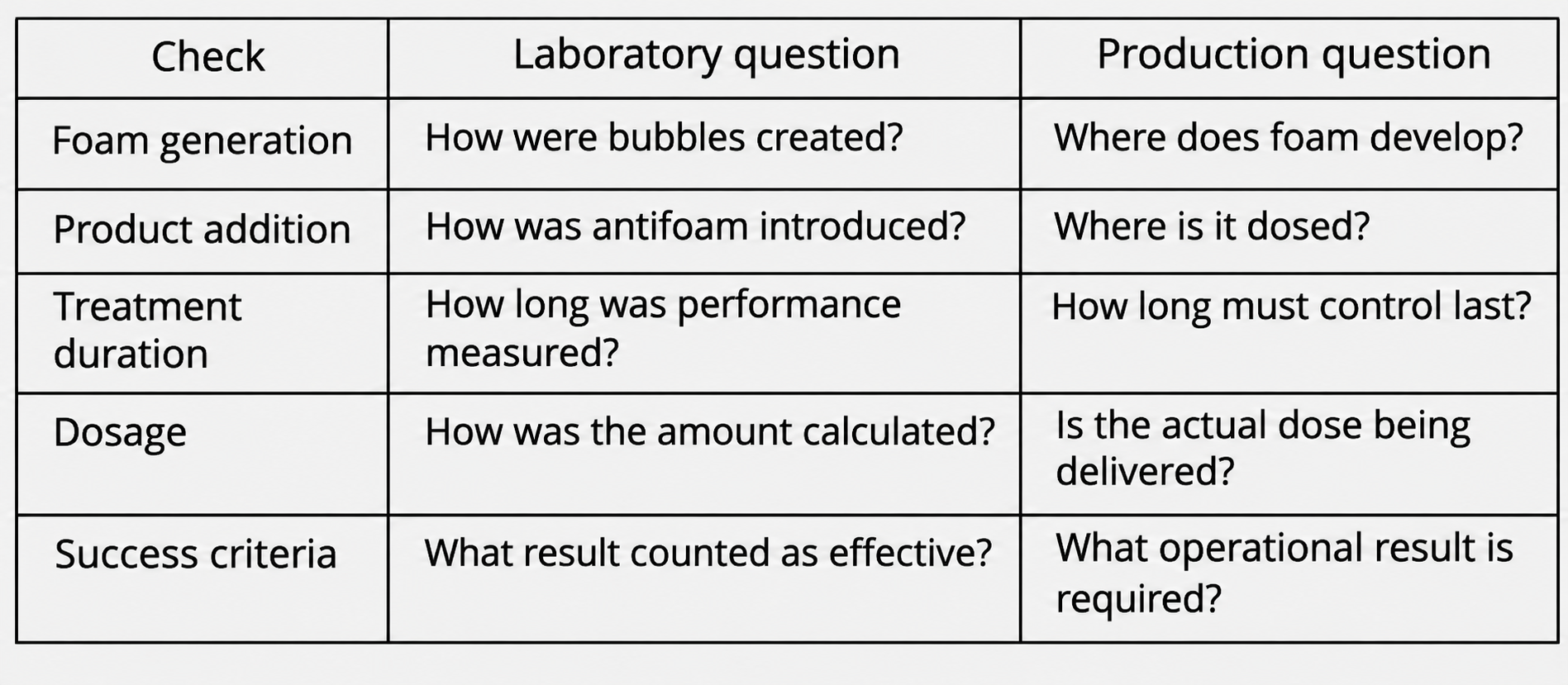
This comparison can reveal whether the issue is related to the testing method, treatment delivery, or the formulation itself.
Does a Successful Shake Test Prove the Antifoam Will Work in Production?
No.
A shake test can be useful for screening and comparing formulations, but it cannot represent every industrial foam problem.
If production foam is caused by continuous circulation, a test involving repeated liquid movement may provide more relevant information.
The objective is not to use the most complicated laboratory method. It is to use a method that reflects the problem being investigated.
At PMC Ouvrie, our research and development team uses different testing approaches to evaluate foam-control performance under application-relevant conditions.
We can support custom defoamer formulation evaluation when a process requires a more specific treatment approach.
What Should You Do Before Repeating the Production Trial?
Once the likely differences have been identified, update the test plan.
A useful sequence is to:
- Define the production problem. Identify the stage where foam appears and the operational effect it causes.
- Review the laboratory method. Check whether it reproduces the relevant foam-generating conditions.
- Confirm treatment delivery. Verify the product, concentration, addition point, and dosing equipment.
- Compare performance over time. Measure whether foam remains controlled for the required period.
- Run an approved plant trial. Confirm the result using agreed operating and product-quality criteria.
Keep a record of the test conditions and results so future trials can be compared reliably.
If the antifoam still underperforms, the formulation may need further evaluation.
How Do You Know When Scale-Up Has Been Successful?
Successful scale-up means the antifoam meets the agreed performance requirements under representative production conditions.
That may include controlling foam without overflow, maintaining stable operation, or reducing unwanted air-related problems.
The treatment must also meet applicable product-quality, equipment, and regulatory requirements.
A laboratory result is valuable, but consistent production performance is the final measure.
Frequently Asked Questions
Can the same antifoam require a different dose in production?
Yes. The effective treatment rate may differ when process conditions, liquid composition, or product distribution change. Any adjustment should be evaluated through controlled testing.
Is a laboratory test still useful if it does not predict plant performance?
Yes. It can help compare formulations and investigate specific variables. The test method may need to be revised to better represent production conditions.
Should you change the antifoam when a production trial fails?
Not immediately. First check whether the test conditions, dosing method, or operating conditions explain the difference. A formulation change may be appropriate if those factors have been addressed.
Need Help Translating Laboratory Results Into Production Performance?
A good laboratory result is an important starting point, but it must hold up under actual operating conditions.
At PMC Ouvrie, we help manufacturers evaluate foam-control formulations for their specific applications.
Contact our team to discuss your testing results and production requirements.