


Why Does Industrial Foam Suddenly Increase During Production?
Industrial foam can suddenly increase when something changes in the process, such as a new raw material, higher mixing speed, contamination, or a change in temperature or pH. These changes may introduce more air into the liquid or make existing bubbles harder to break.
If foam levels were stable earlier in the production run, identifying the causes of industrial foam starts with checking what has changed. Increasing the defoamer dose without investigating the problem may provide only temporary relief.
What Can Cause a Sudden Increase in Industrial Foam?
Several changes can cause foam to appear unexpectedly, even in a process that normally runs without problems.
1. Changes in raw materials
A new raw material batch may contain different levels of surface-active substances. These substances can stabilize air bubbles and make foam last longer.
Review whether the problem started after changing a supplier, ingredient, or material batch.
Compare the relevant material specifications and production records before making formulation changes.
2. Increased mixing or agitation
Mixers, pumps, and circulating liquids can introduce air into a process.
Foam may increase when:
- Mixing speed is raised.
- Pumping or circulation conditions change.
- Liquid returns create more splashing.
- The liquid level drops and exposes a return line.
If foam begins immediately after an equipment adjustment, check the mixing and circulation conditions first.
3. Changes in temperature or pH
Temperature and pH can affect the behavior of foam-forming ingredients and the performance of an existing defoamer.
A formulation that controls foam under normal conditions may behave differently after a significant process change.
Compare current readings with the approved operating range and previous production records.
4. Contamination or cleaning residues
Unexpected foam may appear when cleaning chemicals, detergents, or incompatible materials enter a production system.
This can happen after equipment cleaning, during product changeovers, or when a process stream contains unexpected residues.
If foam develops after cleaning or maintenance, check whether the equipment was returned to service according to the approved cleaning and rinsing procedure.
Don’t assume that contamination is present based on foam alone. Confirm it through the appropriate checks.
How Can You Find What Changed?
Start by comparing the current run with the last run that had acceptable foam levels.
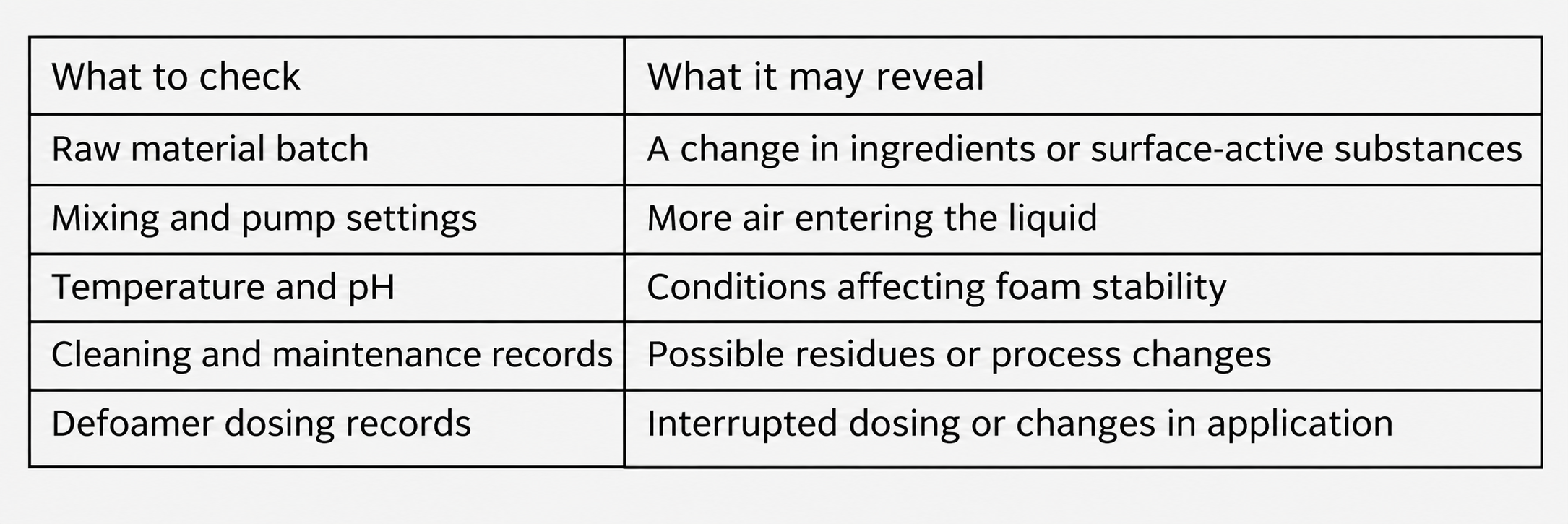
Look at when and where the foam first appeared.
For example, foam that starts immediately after mixing may point toward agitation or ingredient changes. Foam that appears after a cleaning cycle may require a review of cleaning residues.
These observations help narrow the investigation, but they don’t confirm the cause on their own.
Should You Add More Defoamer Immediately?
Not necessarily.
First, check whether the existing dosing system is working as intended. Confirm that the correct product is being used and that the feed rate matches the approved process settings.
If unwanted foam continues, the next step may be to evaluate the defoamer under the current operating conditions.
The right treatment depends on the liquid composition, operating temperature, and other process requirements.
At PMC Ouvrie, we manufacture industrial defoamers and antifoams for a range of processing applications.
Our research and development team can help evaluate suitable formulations when process conditions change.
What If Foam Keeps Returning?
If foam disappears after treatment but returns later, check whether the conditions that caused it are still present.
For example, a defoamer may reduce visible foam while a pump continues introducing air into the liquid.
Repeated foam problems may also indicate changing raw material composition or inconsistent dosing.
Record the timing of each foam increase and compare it with production changes. This can help determine whether the problem is mechanical, chemical, or related to the treatment itself.
For a process-specific example, our article on reducing foam in wastewater treatment explains how changing influent conditions and treatment operations can affect foam.
Frequently Asked Questions
Can industrial foam increase without changing the formulation?
Yes. Changes in mixing, pumping, liquid level, or temperature can increase foam even when the formulation stays the same.
Does sudden foam always mean contamination?
No. Contamination is one possible cause, but air entering the process or changes in operating conditions can also explain a sudden increase.
Can a defoamer stop foam from returning?
An appropriate defoamer may control foam, but recurring problems should also be checked for changes in equipment, ingredients, and operating conditions.
Need Help Investigating Unexpected Foam?
When foam suddenly increases, identifying the change behind it can help prevent unnecessary adjustments and repeated treatment problems.
At PMC Ouvrie, we help industrial manufacturers evaluate foam-control options based on their process requirements.
Contact our team to discuss your application.